
American homeland for the Gottsackers
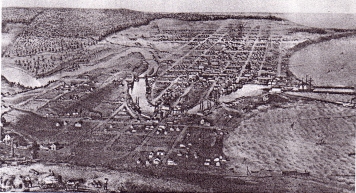
Mayschoss is the German homeland of the Gottsacker family. Sheboygan certainly is the homeland for most of the American Gottsackers. Exactly what drew the first Gottsacker immigrants to Sheboygan is unclear, but it is easy to speculate–a thriving economy, a large German community, and, due to the area’s industries in metal and woodworking, high demand for craftsman. Sheboygan was part of a Wisconsin “German Triangle” that extended from Milwaukee, to Manitowoc, and Madison. In an 1868 book, German Fredrika Bremer described daily activities in German American homes in the German Triangle: “Everywhere Hausfrauen set on the family table dishes of sauerkraut, cole slaw, dill pickles, hot potato salad, sour meats, hasenpfeffer, noodles, dumplings…And, as a pastime, German men continued to prefer Schafskopf [sheepshead] to other card games.” Sheboygan, like other German settlements in the area, was a home away from home for German families.

Holy Name Church
All of the Gottsacker immigrants were Catholics, and their ancestors in Mayschoss were practicing Catholics in the Mayshoss Catholic Church since the beginning of church records in the 1600s. Activities in the church were central to both the immigrant families and the generations that followed. Most of the Sheboygan Gottsackers were members of Holy Name Church. In birth, confirmation, and funeral services a handful of priests are named–all served at Holy Name Church at different times. Father Haider, the priest who designed and presided over the construction of the present Holy Name Church, was one of those priests. Father Haider died in 1884 and was followed by Father Schwaiger, who built the parsonage at a cost of $3,000.
The Thill brothers
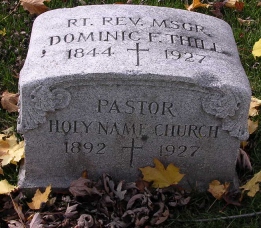
Father Schwaiger was replaced by the first of two brothers Rev. Nicholas Thill in 1889. Father Nicholas Thill’s brother Dominic took over as pastor of Holy Name in 1892. Father Thill was pastor of Holy Name for 35 years–until 1927 and as a result of his long tenure he appears as celebrant at many, many Gottsacker church events. Father Dominic Thill is buried in Calvary cemetery on Sheboygan’s north side as are most of the Gottsackers who lived and died in Sheboygan. Above is the headstone for his grave.
Holy Name School
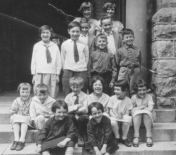
Holy Name school was one of the first three schools in Sheboygan. The first was a semi-public school–parents paid for operating expenses. Its first classes were held in 1836-37 and were taught by F.M. Rublee. Two parochial schools were next: Trinity Lutheran school and St. Mary Magdalen (later renamed Holy Name). The early schools had only two terms–winter and summer. Older children usually only attended the winter session, so that they could work during the summer. Over 1/2 of the children attending these early schools spoke German and several of the schools conducted classes in German. Above are eight sets of twins on the steps of Holy Name school in the mid 1920s. My father, Tom Gottsacker and his twin sister Charlotte are at the far left on the second step. Charlotte later died of a school yard injury.
Gottsackers in Sheboygan
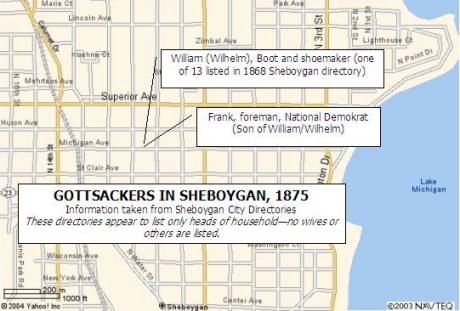
The 1875 Sheboygan City Directory (and those prior to that year) show only two Gottsackers–Wilhelm, the first Gottsacker to move to Sheboygan and his now adult son Frank. Although there are likely a few other Gottsackers in or around Sheboygan, most other Gottsacker families were still living either in Two Rivers or Mt. Calvary. Since both Wilhelm and son Frank were businessmen when they appear in the directory, it is possible the directories only listed business-affiliated individuals. Wilhelm at that time had a shoemaking business on Michigan Avenue near Adam Trestor’s tailor shop and the Gerend Grocery store. Son Frank was listed as a foreman at the National Demokrat newspaper. He eventually would become owner, editor and publisher of the Demokrat.
Gottsacker explosion!
By 1920, the number of Gottsackers in Sheboygan had exploded. Most of them lived on the near north side–so many in fact you could almost call it the “Gottsacker section” of Sheboygan. The explosion was the result of two factors: 1) Several other Gottsackers who initially settled in Two Rivers and Mt. Calvary moved to Sheboygan and 2) they all had large families. Most all attended Holy Name church. Most of the homes of the 1920 Gottsackers are still standing.
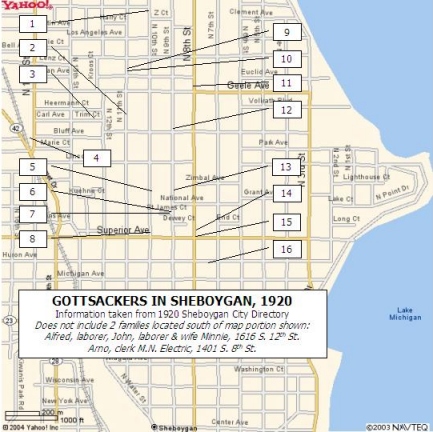
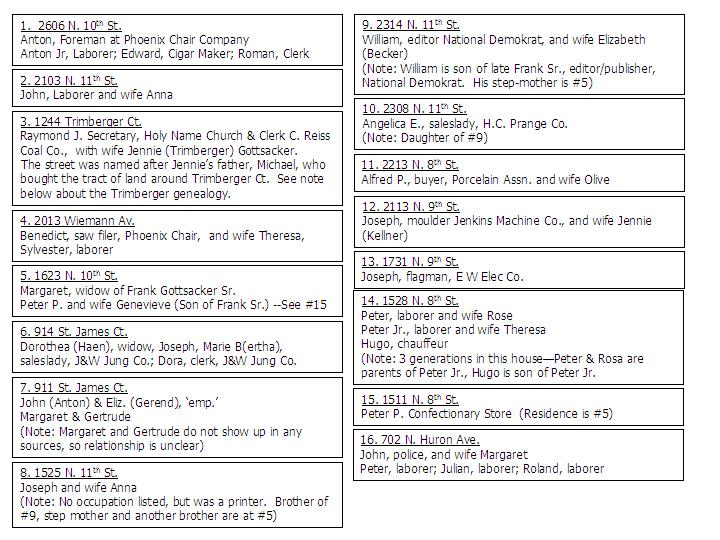
Note #3 above–Trimberger Court, named after Micheal Trimberger, who owned a tract of land in the area. A pdf of a Trimberger family genealogy created in 1942 is located on the ‘Documents’ link.
 The Gottsacker Family Story