
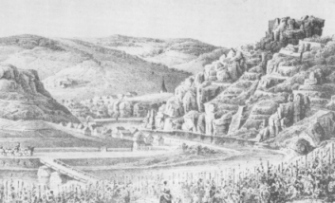
Above is a lithograph of Mayschoss in 1840 done by J.N. Ponsart, a French lithographer who created extensive drawings of the Ahr River Valley and published them in a book around 1840.
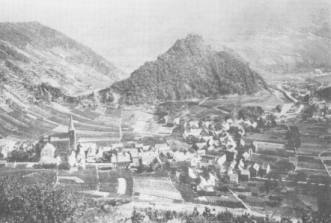
Above: Mayschoss just before the turn of the century (the late 1800s). It was between the dates of these two above graphics of Mayschoss that the Gottsackers who emigrated left Mayshoss for a better life in Wisconsin. The Catholic church in the graphic is the source of all the Gottsacker family genealogy prior to the Gottsacker emigration. Dorfstrasse, the main street in Mayshoss, can be seen just in front of the church. Dorfstrasse continues in the graphic toward the top of the photo until it reaches the Ahr River, which is difficult to see in the graphic. The Ahr River is located just to the right of the base of the mountain in the center of the graphic.
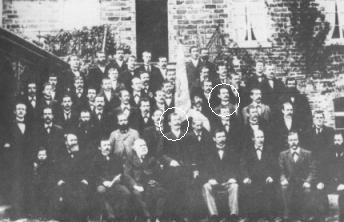
Among the Mayschoss vintners in the above photo taken in 1902 are two Gottsackers, cousins Nikolas Rochus Gottsacker circled at the lower left and Michael Gottsacker circled at the upper right. Both are ancestors of currently living cousins in Germany. The vineyard plots owned by these Gottsackers are still in the family, tended by the family, friends and relatives and can be seen on the ‘German Relatives’ page. An earlier Gottsacker was one of the founding members of the Mayschoss wine cooperative in 1868–the first wine coop in Germany. The second president of the wine coop was a Gottsacker. The two Gottsackers in the photo are descendants of this second president of the wine coop.
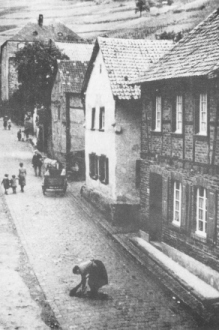
Dorfstrasse, the street shown above, is the main street in Mayschoss and is the street where Franz Gottsacker’s house is located. The photo dates to 1920 and Dorfstrasse is not too much different today. The main highway through town and the Ahr river are located at the end of the street. All of the lithographs and photos on this web page are taken from a book given to me by Franz Gottsacker. The book was created and published by a Mayschoss resident. Nearly all of the photos in the book came from Mayschoss residents.
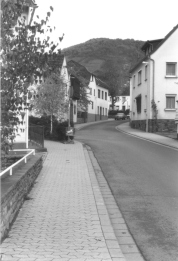
Dorfstrasse in 1991–it hasn’t changed much.
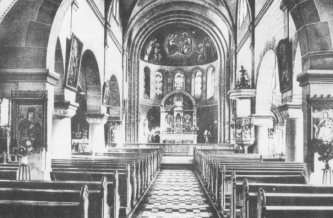
The inside of the Catholic church. There is a graveyard to the right of the church You might think the grave headstones would provide a lot of genealogical information but they don’t. Unfortunately, there is a law in Germany that requires graves to be reused after a period of (as I remember) 30 years. The purpose of the law is to prevent the constant expansion of cemeteries.
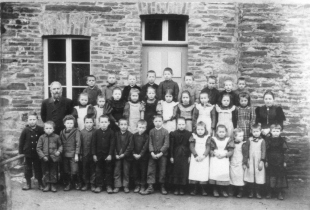
Above is a picture of the students in front of the (small!) Mayschoss school. At the back left is Peter Rochus Gottsacker, headmaster of the school at the time of the picture. Peter Rochus is the great gandfather of some of our cousins in Germany. The picture was taken around 1890. The original Gottsacker immigrant to Mayschoss moved from nearby Muenstereiffel to be the headmaster at this school.

Pictured above is Sebastian Josten, tending to his vineyard in 1930. Although not directly related to the Gottsackers, there were many intermarriages between Jostens and Gottsackers in Mayschoss. The same is true of the Ley families and the Gottsackers in Mayschoss.
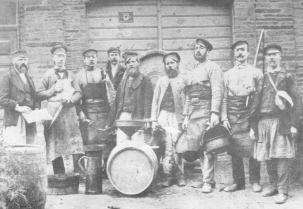
In this photo of Mayschoss vintners from 1883, the person at the far left is Anton-Josef Ley. He was the head wine maker at the wine cooperative at the time. He is the maternal grandfather of our Gottsacker cousins born and raised in Mayschoss. This photo is often used by the winery in promotional material,
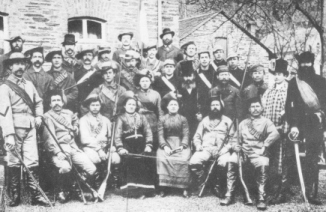
The woman sitting in the center of the photo (long black dress) is a sister of Maria Cossman Gottsacker. Maria Cossman Gottsacker is the mother of Franz and grandmother of our cousins born and raised in Mayschoss. The photo was taken in 1902 and is of a theatre group presenting the play “Die Heldenbuuren von Transvaal”.
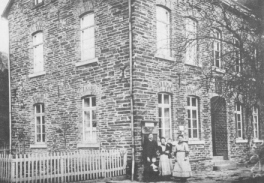
Above is a photo of the Ley house on Dorfstrasse in 1913. In the photo are Franz-Hubert Ley and his early family. This family is directly related to the Franz Gottsacker family–Hubertine Ley, a daughter of Franz-Hubert was Franz’s wife. Aunts of our cousins born and raised in Mayschoss are also in the photo. Some of these aunts were still living at the time of my first visit to Mayschoss in the early 1990s. Pictured are ‘aunts’ Hetta and Louise, and ‘uncle’ Hubertus. The house at one time also served as a post office.
 The Gottsacker Family Story