
Three families start a town
There’s a very small town in South Dakota that wouldn’t exist if it weren’t for three families and a series of intermarriages between the families. In 1879 Joseph Altenhofen and his wife Rosa Gottsacker Altenhofen settled in the county of Hanson, South Dakota. They were soon joined by two of Rosa’s sisters and their husbands John and Jacob Schladweiler. The Altenhofens, Gottsackers and Schladweilers were the pioneers of what would eventually become Farmer, South Dakota.
From a history of Farmer, SD:
When Joseph Altenhofen saw the lush land spread out for miles, he thought it a farmer’s paradise where they could produce good crops and live the good life.
The Chicago, St. Paul, Milwaukee and Omaha Railroad came through in 1887 and located a desirable place for a townsite near the creek. Mr. Altenhofen, with great enthusiasm for the country, said he would give five acres of right-of-way if they would locate on his land farther east. This was agreed upon. He also gave twenty acres for a townstte and suggested the new settlement be called Farmer.
A patent was issued to Joseph Altenhofen, June 30, 1886 for the NE1/4-17-103-57 (Edgerton Township). For a consideration of $1.00, he deeded five acres to the railroad August 8, 1890.
The Farmer townslte was surveyed March 1, 1892 by H. C. Greene for Joseph Altenhofen and platted March 15, 1892. South Farmer was surveyed by L. M. Stanton for Henry Utting and named Henry Otting Addition on September 24, 1901. The town was not incorporated until April 7, 1920.
Records show that another five acres of the Altenhofen land was deeded to the Right Reverend Martin Marty, Roman Catholic Bishop of South Dakota, undoubtedly for the church and day school. The church was built in 1893. Father Auer helped build the church and he was then transferred to Dimock where he helped build their tall, spired church. The boarding school opened about 1908, with four sisters instructing some sixty children. Father Scheler of the church from 1917 until 1936, built a grotto on the grounds from beautiful stones of many varieties that he brought from the Black Hills of South Dakota.
What they had in common
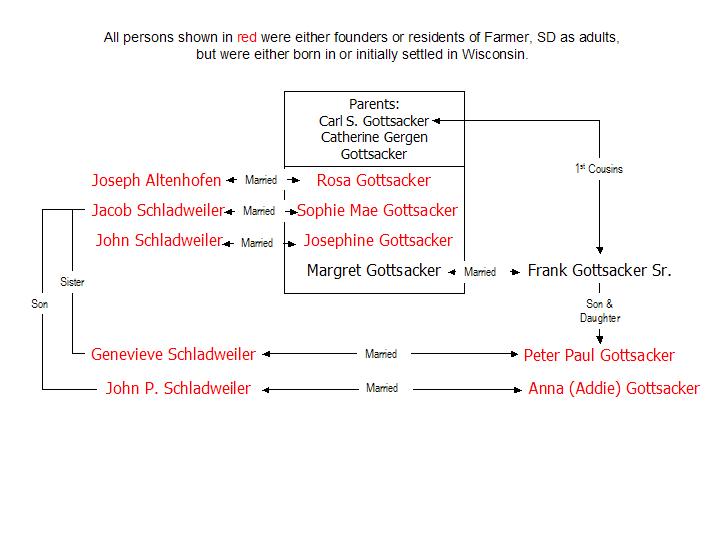
The Altenhofens, Gottsackers and Schladweilers all had one thing in common: They were either born in or initially settled in Southeastern Wisconsin, primarily around Sheboygan. In a time when communication and travel were slow and inconvenient, it is understandable that brothers would marry sisters of another family, especially in a small town where the courting choices just weren’t that plentiful. But the intermarriages tied to Farmer, SD are unusual in that they involve just a few families and even a marriage between cousins. One of these marriages was the second for Frank Gottsacker Sr., my great grandfather and a very well known figure in Sheboygan.
After his first wife, Anna Brandt died, Frank Gottsacker Sr. married the daughter of his first cousin, Carl Sebastian Gottsacker. The daughter’s name was Margret Gottsacker, so her full married name became Margret Gottsacker Gottsacker, although that probably wasn’t talked about very much at the time. News articles announcing the marriage declared that Margret Gottsacker was not related to Frank Gottsacker. But in Frank Gottsacker’s own chronicle he states he married the daughter of his first cousin. Perhaps newspapers at the time did not want to offend such a public figure–Frank Sr. had been editor and publisher of the National Demokrat and went on to serve as postmaster, on the school board, as a county commissioner and was also a member of the Wisconsin State Democratic Committee.
Not a company town–a family town…
In any case, Farmer became a town of intermarriages, and probably all for the better. The following diagrams illustrates how Farmer became a true family town.
The founders, Joseph and Rosa Gottsacker Altenhofen
In 1879, the Altenhofen’s settled in Hanson, South Dakota on the land that would eventually become Farmer, SD. The Chicago, St. Paul, Milwaukee and Omaha Railroad came through the area in 1887 and noted that land around a nearby creek would be a suitable place for a town site. Joseph Altenhofen told the railroad he would give them five acres right of way if the would locate the rail line further east, on his property. The railroad agreed.
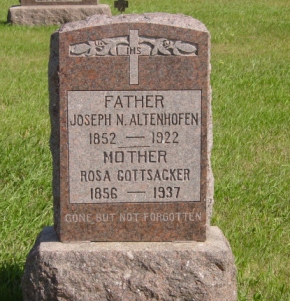
Grave marker of Joseph and Rosa in Farmer, SD. Photo provided by great-grandaughter Lisa Davidson.
Land for a church and another Schladweiler
Joseph and Rosa Altenhofen also donated five acres of his land for a church. The land was deeded to Right Reverand Martin Marty, Roman Catholic Bishop of South Dakota. The church was built in 1893 under the guidance of a Father Auer. Margaret Schladweiler, daughter of Joseph and Rosa attended school in school in Milwaukee. After receiving her education she moved to Farmer and operated a dress shop. With such a meager population, it is not surprising that the dress shop lasted only a year. Margaret returned to Milwaukee and became a nun.
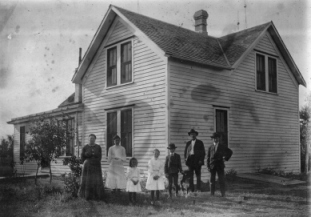
The house in Farmer, SD circa 1907: Rosa Gottsacker Altenhofen, Katherine, Anne, Mary, William, Joseph and Joseph Peter Altenhofen. Thanks to Lisa Davidson for the photo.
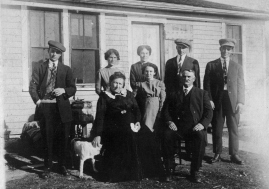
The Gottsacker/Altenhofen family. Front: Rosa (Gottsacker) Altenhofen, Anne, Joseph. Back: William, Mary, Katherine, Frank Roster (Katherine’s husband) and Joseph Peter. Thanks to Lisa Davidson for the photo.
Jacob and Sophie Gottsacker Schladweiler
In 1884, the Altenhofens were joined by Joseph and Rosa’s sister Sophie Gottsacker Schladweiler. Jacob and Sophie lived on Main Street, and according to an informal history of Farmer by an unknown author, “People gathered at their place for Sunday ball games and most of the people stayed for supper. Apparently she [Sophie] managed well to have that much food for such a crowd of people each week. Food was hard to come by in those days.“
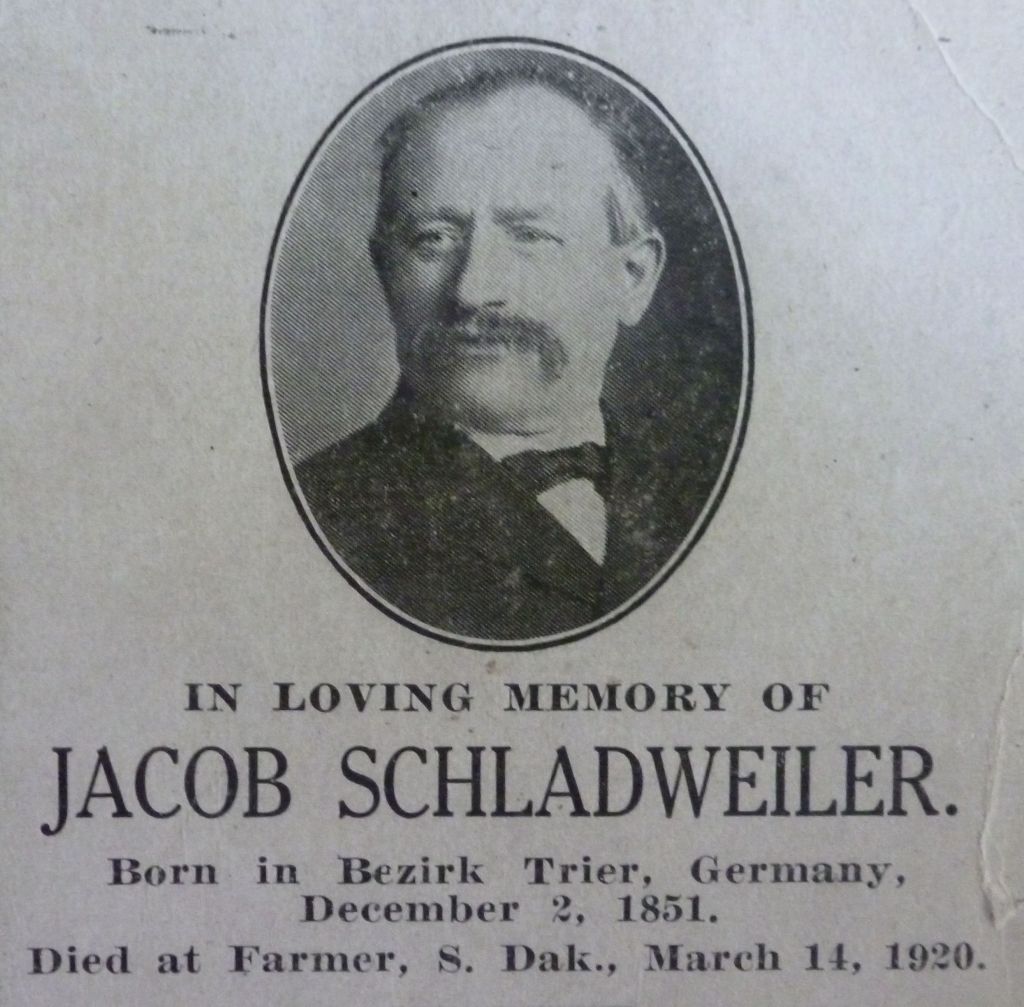
John and Josephine Gottsacker Schladweiler
Also in 1884, another related couple moved to Farmer–Jacob Schladweiler and his wife Josephine Gottsacker (sister of Rosa and Sophie Gottsacker). John and Josephine moved to Farmer in style. They framed their house while they still lived in Wisconsin (almost surely Sheboygan) and shipped the framed house in pieces to Farmer on the railroad. Since the railroad had not yet come through Farmer itself, it is unclear where the final rail head was located, but it must have been quite an operation to moved a house in pieces from the rail head to its final destination in the late 1800s. The couple also brought a cow, sheep, some horses, and their personal items via the railroad.
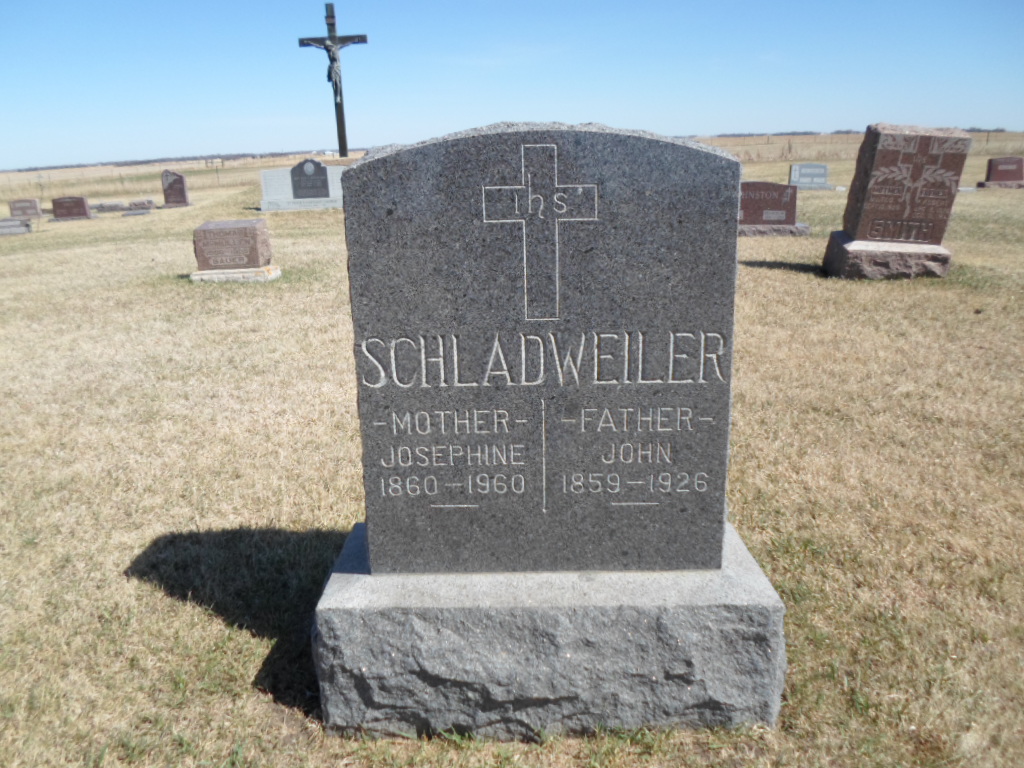
John Schladweiler–civic leader
John Schladweiler apparently was very active in civic affairs. He served four years on the Town Board and ten years on the school board. In 1904, he was elected to serve four years as County Commissioner and his conduct in public office earned him the nickname “Honest John”. John and his wife Josephine moved to nearby Mitchell in 1917, lived there until 1925 and then moved back to Farmer. A year after they returned to Farmer, John Schladweiler died.
Josephine lives forever…almost
Josephine was as active in the Farmer Catholic church as her husband John was in civic affairs. Josephine lived 35 years beyond John’s death–just 5 months shy of 100 years old. According to the Farmer history mentioned earlier, “She attributed her longevity to the fact that she worked hard and ate the things she enjoyed eating. Onions and a slice of homemade bread were good.” The Rev. Alphonse J. Schladweiler, Bishop of New Ulm, Minnesota and Josephine’s nephew conducted the funeral services.
More Gottsackers, more Schladweilers
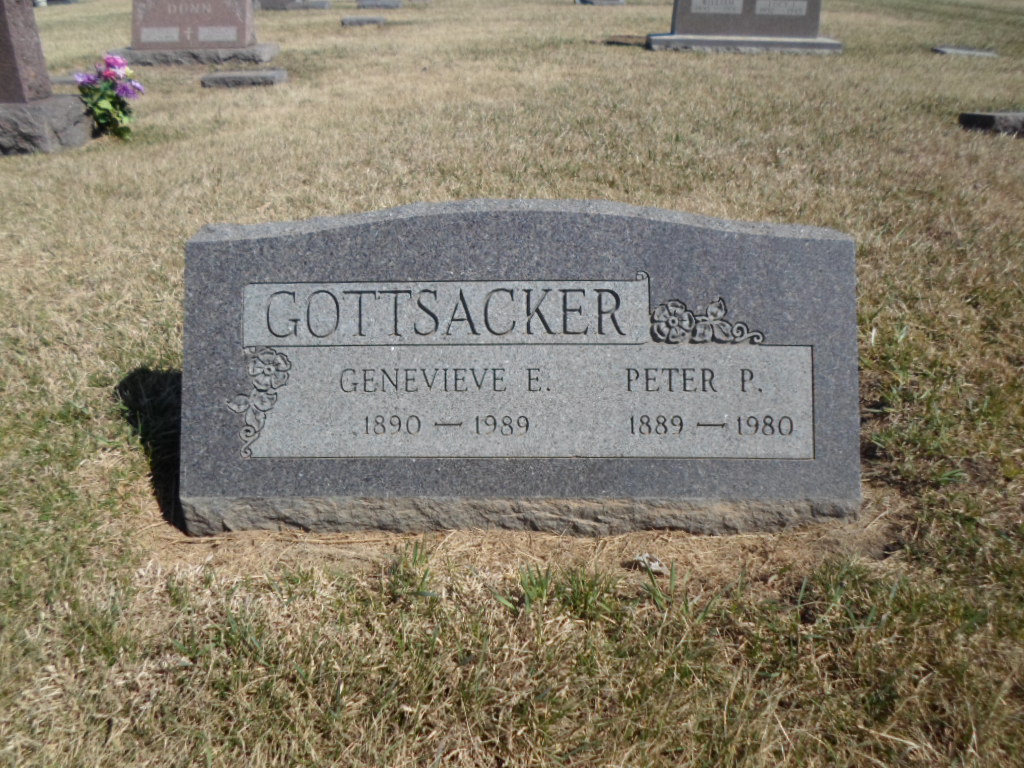
Many years after these pioneer Altenhofen, Gottsacker and Schladweilers established the little town of Farmer, two more couples of Schladweilers and Gottsackers moved to Farmer. Both were my direct ancestors–my grandfather’s sister Addie and my grandfather’s brother Peter. Addie married John P. Schladweiler, who was born in Farmer. Peter married Genevieve Schladweiler, but it took this couple a while to make the move to Farmer.
The confectionary store
Prior to moving to Farmer, Peter and Genevieve Schladweiler Gottsacker owned and operated a confectionary store in Sheboygan at 1511 N. 8th St. in the “Gottsacker” section of town. Maybe the confectionary store was part of a grand plan to save enough money to establish a successful farming operation in South Dakota. Or, maybe they went to South Dakota because the confectionary store just didn’t do very well. I prefer the first version. No matter the reason for the store, I have great memories of that store. I still remember begging to go to ‘the candy store’ as a child when visiting grandma and grandpa in Sheboygan (long after Peter and Genevieve had sold and left for Farmer). Grandma never really wanted me to go, but she had a soft heart and before giving me the final OK to go, she would always remind me that it used to be owned by a Gottsacker. I distinctly remember coming back from the store with a ‘pack’ of fake cigarettes that were nothing but rolled paper with some flour inside to simulate smoke. She thought it was just terrible that such a thing could be sold to kids in a candy store. This, despite that fact that grandpa Joe smoked constantly and eventually died of throat cancer. I guess she was just way ahead of her time.
More about Farmer, SD…
If you are interested in reading more about Farmer, SD, a short document on Farmer history is available for download on the ‘Documents’ page.
 The Gottsacker Family Story